Explore the Space
- Room-to-room navigation
- Apartment mini-map
- Interactive object hotspots
- Smart device cards
3D Web · Voice UI · Smart Home
A virtual apartment turns Sber's smart device catalogue into a living product experience: users move between rooms, interact with objects, control devices by voice and talk to an AI assistant within the space.
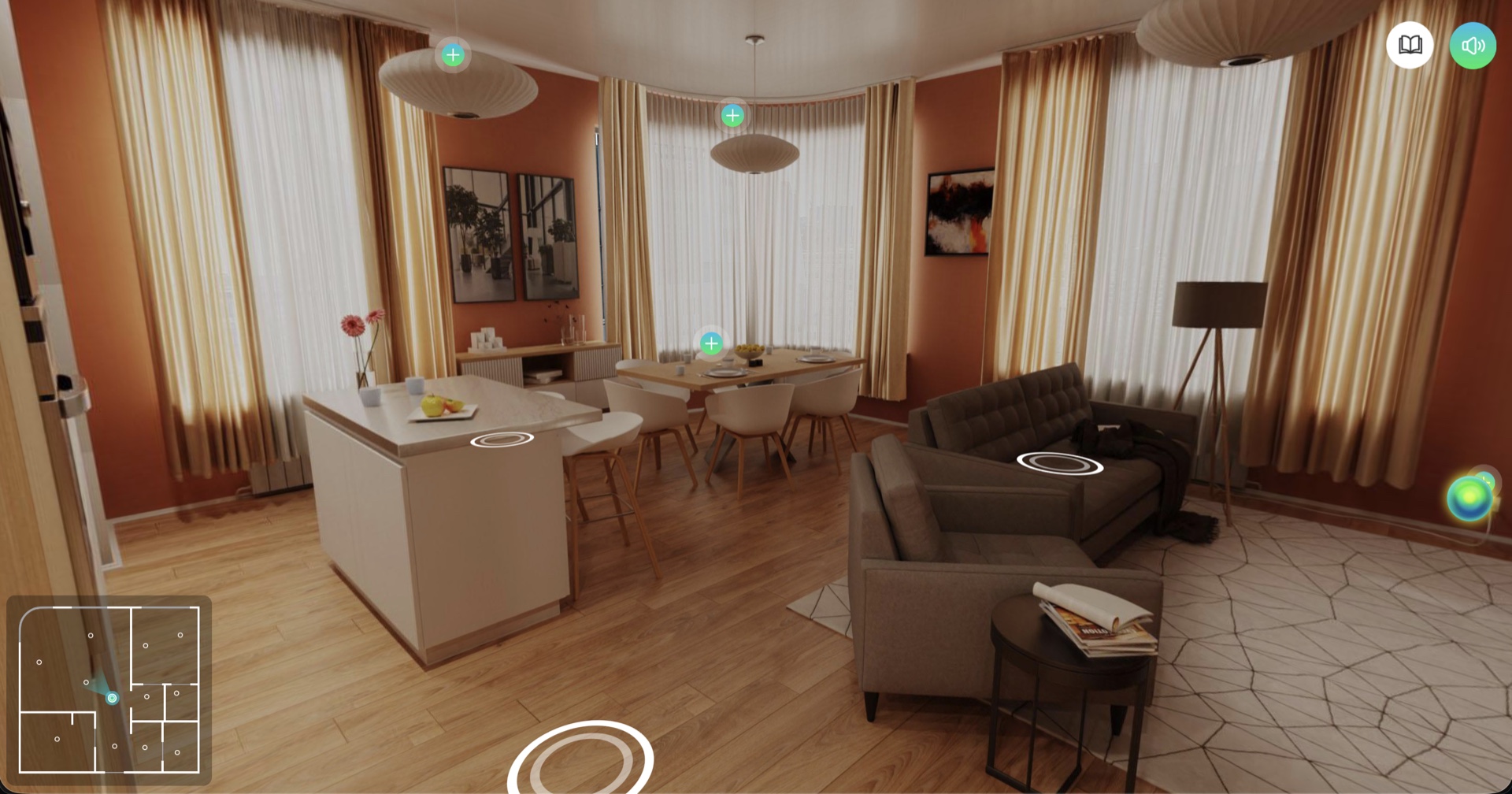
Sber Smart Home 3D Showroom is an interactive virtual apartment where products are demonstrated through everyday scenarios. Instead of browsing a static catalogue, users explore rooms, move between viewpoints, open device cards and immediately try the related actions.
The experience needed to combine 3D navigation, product content, voice control and AI conversation in one clear interface. Users had to understand where they were in the apartment, which objects were interactive and whether each action could be triggered by voice or directly through the interface.
I provided technical leadership for the interactive experience, shaping the architecture of the user journeys and coordinating the 3D layer, voice commands, AI chat and integrations with the devices and media services being demonstrated.
The product is built around a panoramic 3D space with navigation points and interactive hotspots. The interaction layer connects each selected object to its product card, available voice commands, assistant conversation and device control scenarios.
Users begin by freely exploring the space, then move from discovery to action: select an object, receive a contextual prompt and launch the relevant scenario by voice or through the interface.
The panoramic scene combines navigation, a mini-map and product interaction points.
Users can open or close the curtains with a Salut voice command.
An interactive point introduces the device directly in the context of the room.
A voice scenario lets users choose a genre and launch media content on the television.
The content layer stores device descriptions, prompts, voice scenarios and commands associated with each object. The interaction layer synchronizes the room state with user actions such as opening curtains, controlling the television and selecting media content.
The showroom turns smart home capabilities into a clear interactive narrative. Users do not simply read device specifications; they see products in the context of a real room and immediately test the key interaction scenarios.